
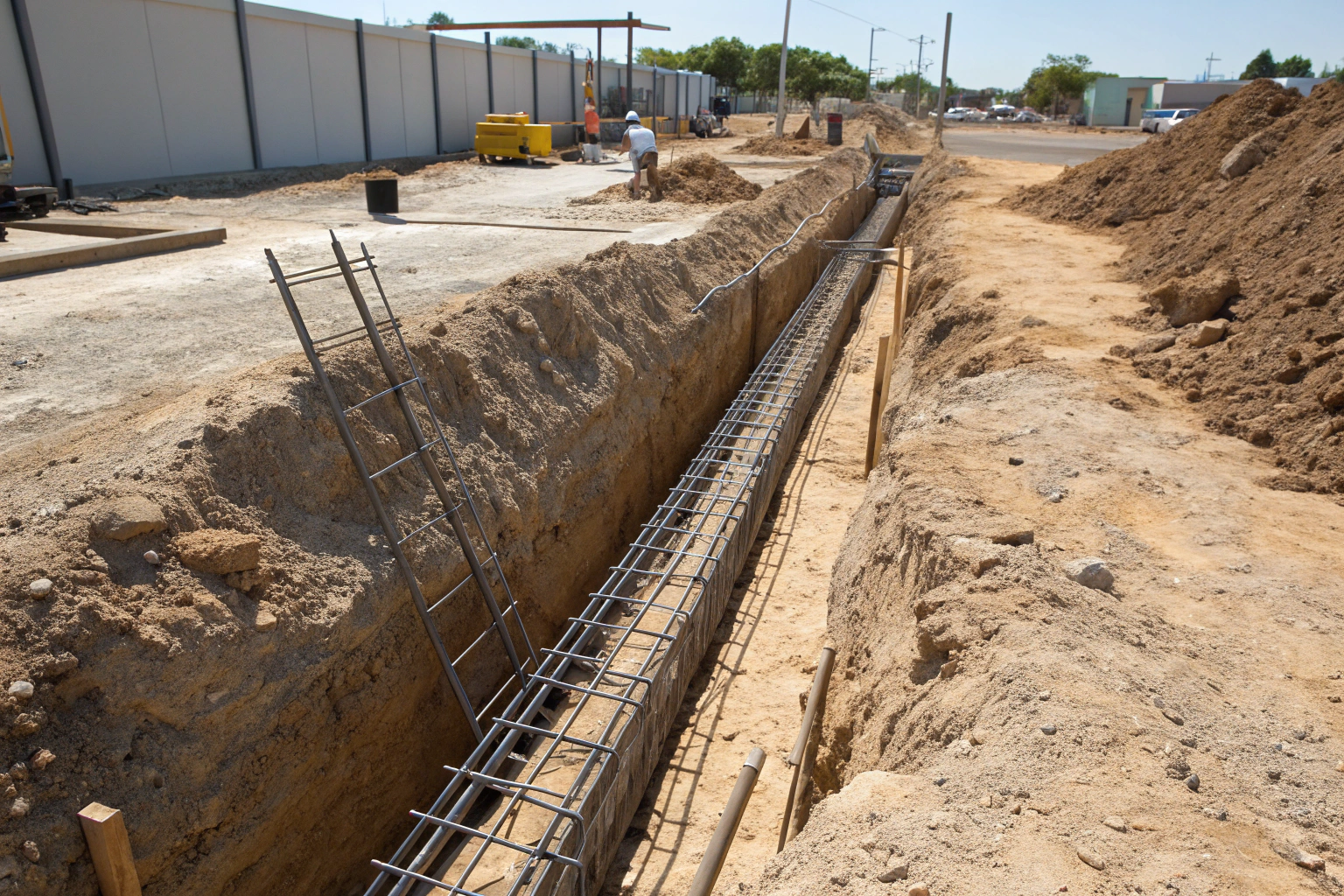
What Are Strip Footings?
A strip footing is a continuous concrete beam poured along the line of load-bearing walls and frames, distributing the structural load of a building evenly into the ground below. Also called a wall footing, it runs the full length of each load-bearing wall — forming a connected network of foundations beneath the structure above.
Strip footings are used across residential, commercial, and light industrial construction in Queensland. They’re particularly well-suited to:
- New home construction on stable, competent ground
- Extensions and additions to existing homes
- Granny flat and secondary dwelling construction
- Masonry wall and brick veneer construction
- Light commercial building frames
On the Fraser Coast, strip footing design accounts for local soil conditions — including sandy coastal soils, reactive clay, and variable bearing capacity across the Hervey Bay region.

What Are Strip Footings Used For in Hervey Bay?
Strip footings are the foundation system behind most of the residential and light commercial construction happening across the Fraser Coast right now. Here’s where we use them.
How Strip Footings Are Constructed — The Right Way
There’s a right way to pour strip footings and a wrong way. The wrong way shows up later — in cracked walls and failed inspections. Here’s how we do it.
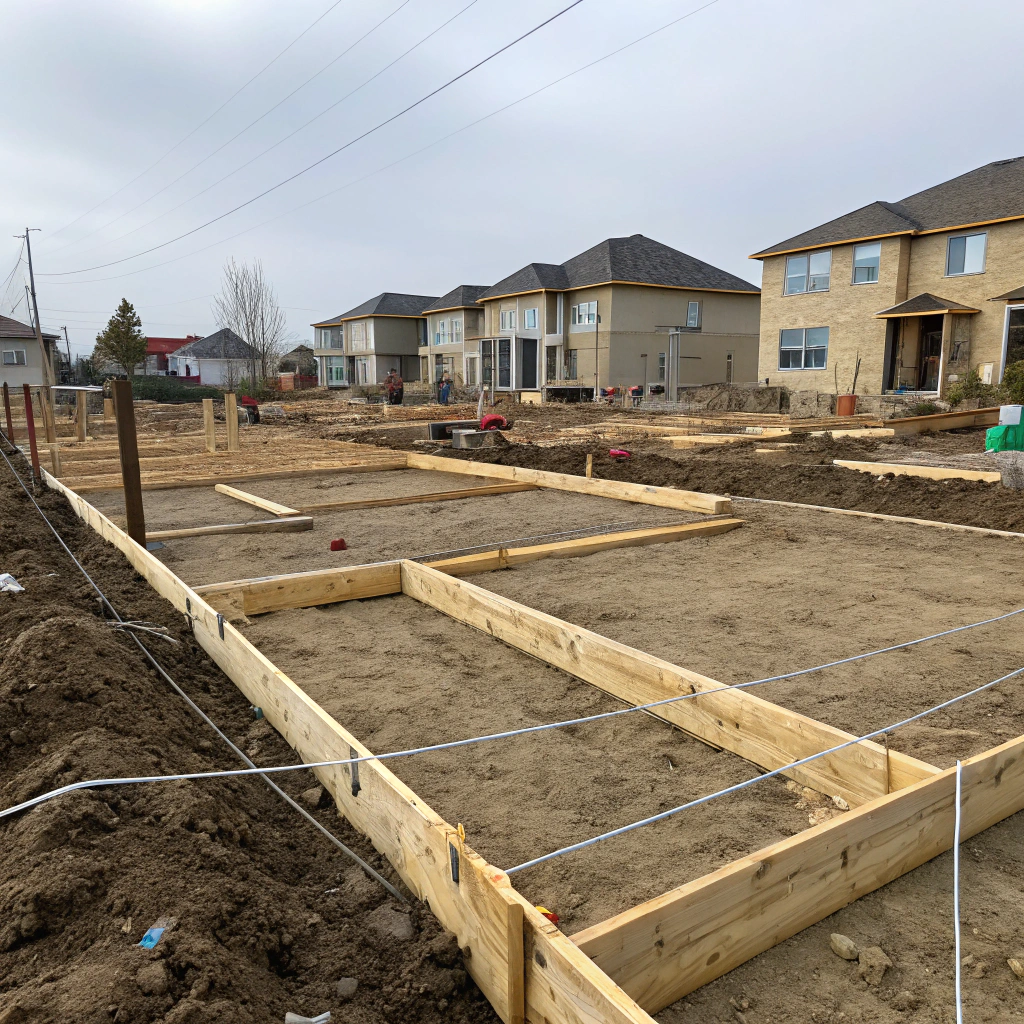
Setting Out to Engineer’s Drawings: Every footing starts with an accurate set-out directly from the structural drawings and approved building documents. We mark out footing locations to the specified dimensions, check everything before trenching begins, and flag any site discrepancies with the engineer before work proceeds.
Trenching to Correct Depth & Width: Trench dimensions are specified by the engineer based on soil classification and load requirements — not estimated on the day. We excavate to the correct depth and width, check the trench base for soft spots or disturbed material, and address any issues before reinforcement goes in.
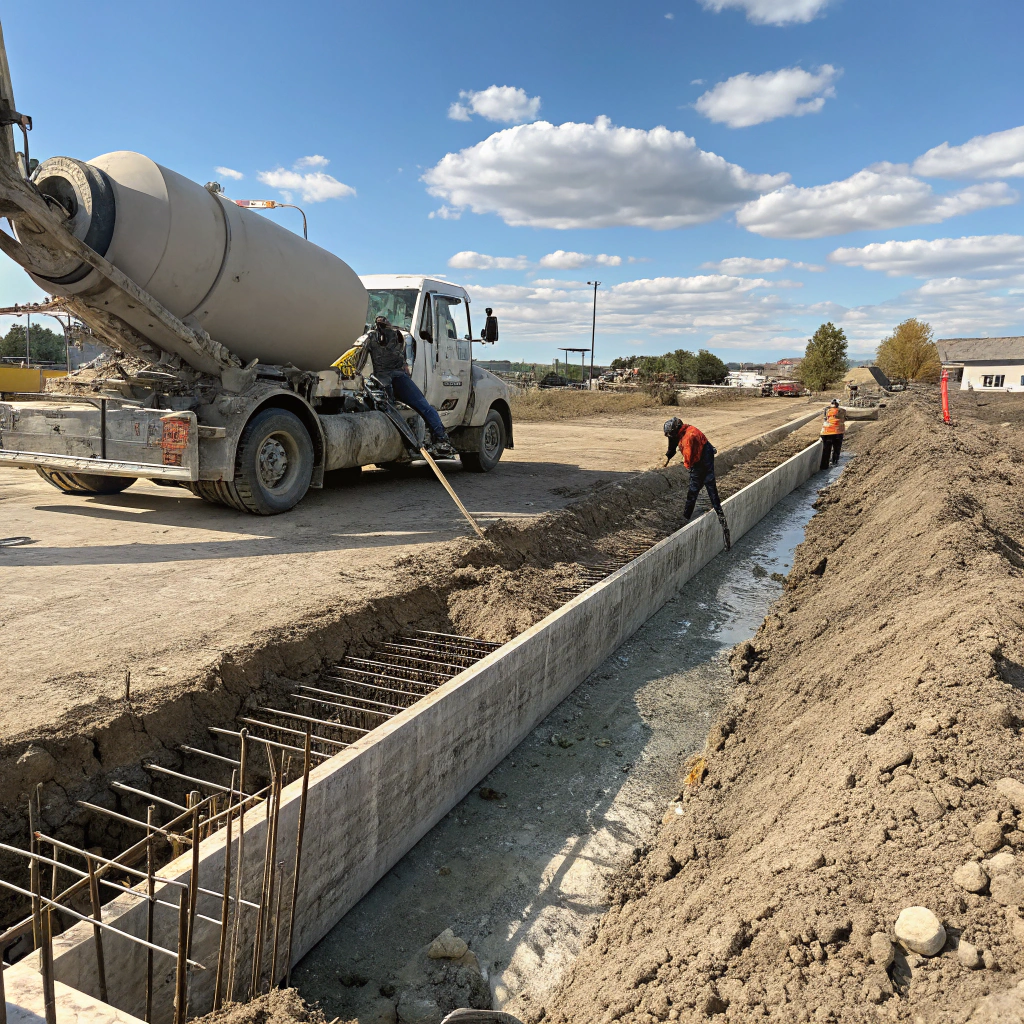
Reinforcement Placement & Concrete Pouring: Steel goes into spec, concrete gets poured to the correct mix — in that order, every time. The reinforcement bar is placed and tied to the size, spacing, and cover that the engineer has specified. Concrete mix is selected to match the site’s exposure classification, and pours are kept continuous where possible.
Soil Conditions on the Fraser Coast & Why They Matter
Hervey Bay’s soils range from sandy coastal lots close to the water to reactive clay further inland that expands and contracts with seasonal wet and dry cycles. That movement is what causes footings — and the structures above them — to crack and shift over time.
Before any footing is designed, a soil classification is carried out on site. That classification determines the depth, width, reinforcement, and concrete mix the engineer specifies. Skipping that step is how strip footings fail.
We’ve worked across Hervey Bay, Pialba, Urangan, Torquay, Eli Waters, and Kawungan. We know the ground conditions that come up repeatedly across the Fraser Coast, and we factor that local knowledge into every job.
Reinforcement & Concrete Requirements for Queensland Footings
Getting the steel and the mix right isn’t optional — it’s what separates a footing that lasts from one that doesn’t.
Steel Reinforcement to Australian Standards
Reinforcement in strip footings is specified by the structural engineer and placed to AS 2870 — the Australian Standard for residential slabs and footings.
Every bar is the correct size, placed at the correct spacing, and held at the correct cover from the trench face and base. Cover is especially important in Hervey Bay’s coastal environment, where salt air accelerates steel corrosion in under-protected concrete.
Concrete Mix Specification & Exposure Classification
Concrete mix selection is driven by the site’s exposure classification — a rating that accounts for environmental conditions, including proximity to the coast.
In Hervey Bay, coastal exposure means higher-strength mixes are commonly specified to protect embedded steel and extend the working life of the footing. We pour into the mix the engineer specifies — no substitutions.
Strip Footings vs Other Footing Types
Different projects call for different foundation systems. Here’s how strip footings compare to the other footing types commonly used in Queensland residential and light commercial construction.
| Footing Type | Best Suited For | Key Advantage | Limitation |
|---|---|---|---|
| Strip Footings | Load-bearing walls, brick veneer, extensions | Continuous load distribution along wall lines | Not suited to highly reactive or unstable soils without engineer input |
| Slab-on-Ground | Single storey residential, shed floors | Combined footing and floor in one pour | Less flexible for sloping sites or variable soil conditions |
| Pier & Beam | Sloping sites, soft or variable soils | Elevated structure, minimal excavation | Higher cost, more complex construction |
| Raft Slab | Reactive clay soils, challenging sites | Engineered for soil movement | Heavier engineering requirements, higher cost |
The right footing system for your project depends on your soil classification, site conditions, building design, and engineer’s recommendation. If you’re not sure what system your project needs — that’s exactly the conversation to have before you break ground.
Strip Footing Inspections & Compliance in Queensland
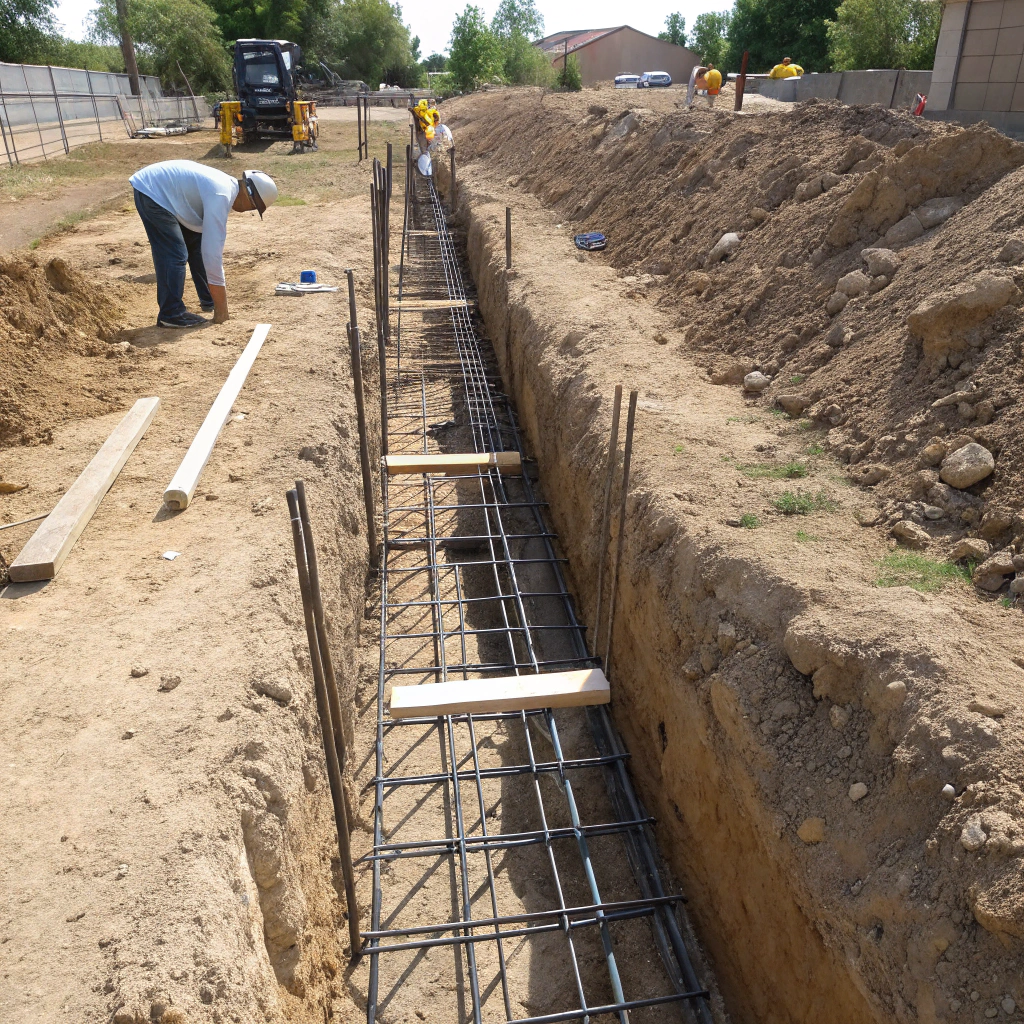
In Queensland, strip footings are a mandatory inspection stage under the building approval process. Before any concrete is poured, the footing trench and reinforcement must be inspected and approved — either by a private building certifier or a local council building inspector, depending on the approval pathway.
That means the set-out has to be right, the trench dimensions have to match the drawings, and the reinforcement has to be placed correctly before anyone shows up to inspect. There’s no patching it after the pour.
Every footing we complete is prepared with inspection in mind from the moment we start setting out. We work to the engineer’s drawings, we don’t cut corners on reinforcement placement or trench depth, and we’re ready when the inspector arrives. Our footings pass — because they’re built to pass.
Why Choose Coastal Concreters Hervey Bay
Strip footings aren’t a job for whoever’s available — they’re the part of your build that everything else depends on. We’re a Fraser Coast concreting business that works exclusively in this region, which means we know the soils, the certifiers, and the conditions that affect how concrete performs here.
We work directly from the engineer’s drawings on every job. We don’t estimate trench depths or approximate reinforcement placement — we build to spec, prepare for inspection, and pour concrete mixes suited to Hervey Bay’s coastal exposure environment.
Whether you’re an owner-builder, a builder looking for a reliable subcontractor, or a homeowner extending an existing home, get in touch for a free strip footing quote. We service Hervey Bay and the surrounding Fraser Coast areas.
Strip Footings Hervey Bay — Frequently Asked Questions
A strip footing is a continuous concrete beam poured along the line of load-bearing walls. It distributes the structural load of a building evenly into the ground below and forms the connected foundation network beneath the structure above.
Depth is determined by the structural engineer based on your site’s soil classification. On the Fraser Coast, soil conditions vary significantly — sandy coastal lots and reactive clay inland both influence the depth and width the engineer specifies.
Yes. Strip footings are a mandatory inspection stage under the Queensland building approval process. The trench and reinforcement must be inspected and approved before any concrete is poured.
A structural engineer designs the footing system based on your site’s soil classification, the building design, and load requirements. We work directly from those engineers’ drawings on every job.
Mix selection is driven by the site’s exposure classification. In Hervey Bay, coastal proximity commonly requires higher-strength mixes to protect embedded steel and extend the life of the footing.
Yes — extensions and granny flats are among the most common strip footing jobs we do across the Fraser Coast. New footings must meet current Queensland building standards regardless of the age of the existing structure.
Get a Free Strip Footing Quote — Hervey Bay & Fraser Coast
Ready to get your footings right from the start? Contact Coastal Concreters Hervey Bay before you break ground on your new build, extension, or granny flat.
- Call us for a straight answer and a free quote
- Submit an online enquiry, and we’ll get back to you promptly
- View our work in our concreting gallery
We work with owner-builders, licensed builders, and homeowners across Hervey Bay, Pialba, Urangan, Torquay, Eli Waters, Kawungan, and the broader Fraser Coast region.
[Call Now — 0741449742]
