
Our Concrete Footpath Solutions
At Coastal Concreters Hervey Bay, we create high-quality concrete footpaths to enhance your property. Whether you need a simple walkway to your front door, a path around your garden, or a connection between different areas of your property, we have the right solution. Our concrete footpaths are built to last, providing safe and reliable walkways for your home or business.
Expert Installation Process
Our team follows a careful step-by-step process to ensure your footpath is installed correctly:
- We visit your property for a free consultation and measurement
- We prepare the area by clearing and levelling the ground
- We build strong wooden forms to shape your footpath
- We mix and pour fresh concrete to the perfect consistency
- We finish the surface to your preference (smooth, textured, or decorative)
- We allow proper curing time to ensure maximum strength
- We remove the forms and clean up the area completely

What Makes a Quality Concrete Footpath Installation
Ground preparation is where every quality concrete footpath begins. Before a single load of concrete is poured, the base underneath needs to be excavated to the correct depth, cleared of organic material, and compacted to a stable, consistent foundation. A poorly prepared base is the most common reason footpaths crack, shift, or settle unevenly over time — and it’s not something that can be corrected after the pour.
Slab thickness, reinforcement, and control joint placement are the next layer of quality. The right thickness depends on the expected foot traffic load and the ground conditions beneath. Reinforcement is incorporated where the application demands it, and control joints are cut or formed at calculated intervals to manage how the concrete moves as it cures and responds to temperature changes across Hervey Bay’s coastal climate.
Surface finish and drainage complete the picture. A footpath that sheds water cleanly and provides reliable grip underfoot performs better and lasts longer than one laid without attention to falls and texture. These aren’t details we leave to chance — they’re built into how we plan and execute every concrete footpath installation across the Fraser Coast.
Control Joints and Crack Management in Concrete Paths
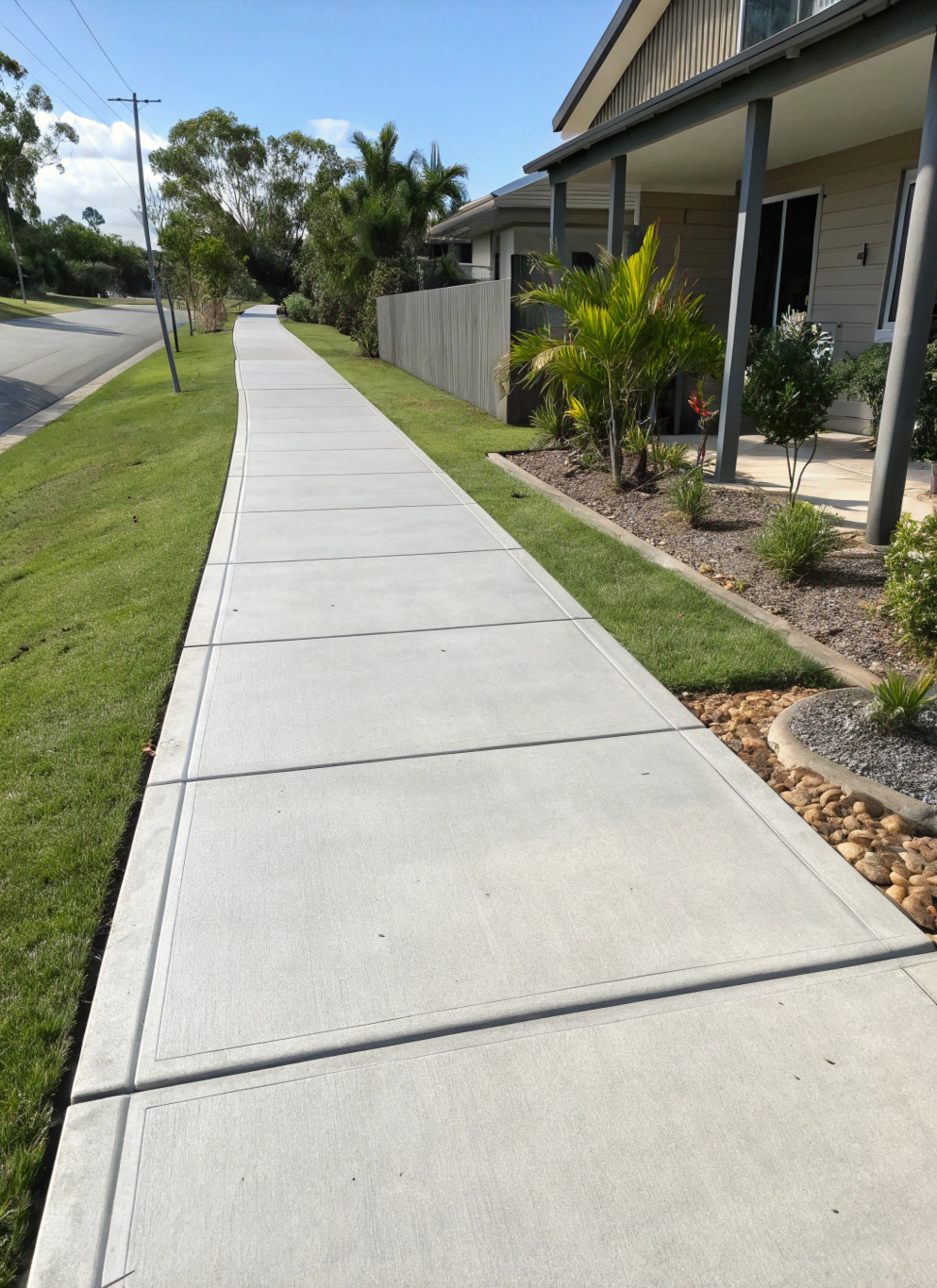
Concrete moves. It expands and contracts with temperature shifts, and it shrinks slightly as it cures — that’s just the nature of the material. Without control joints placed at the right intervals, that movement has nowhere to go, and the slab will crack where it wants to, rather than where you’d want it to. Control joints give the concrete a predetermined point of weakness, so any movement is directed and managed rather than random.
For footpaths, we space control joints based on the width and thickness of the path. A general rule is that joint spacing shouldn’t exceed two to three times the slab width in metres — so a one-metre-wide path would typically have joints placed every two to three metres along its length. In Hervey Bay’s climate, where summer heat and seasonal humidity put additional stress on outdoor concrete, getting this spacing right is particularly relevant.
Joints can be formed during the pour using a grooving tool, or saw-cut shortly after the concrete has set to the right strength. Both methods are effective when timed and executed correctly. Combined with proper base preparation and appropriate mix design, well-placed control joints are one of the most reliable ways to keep a concrete footpath looking clean and performing well for years across Fraser Coast properties.
Concrete Footpath Surface Finishes and Options
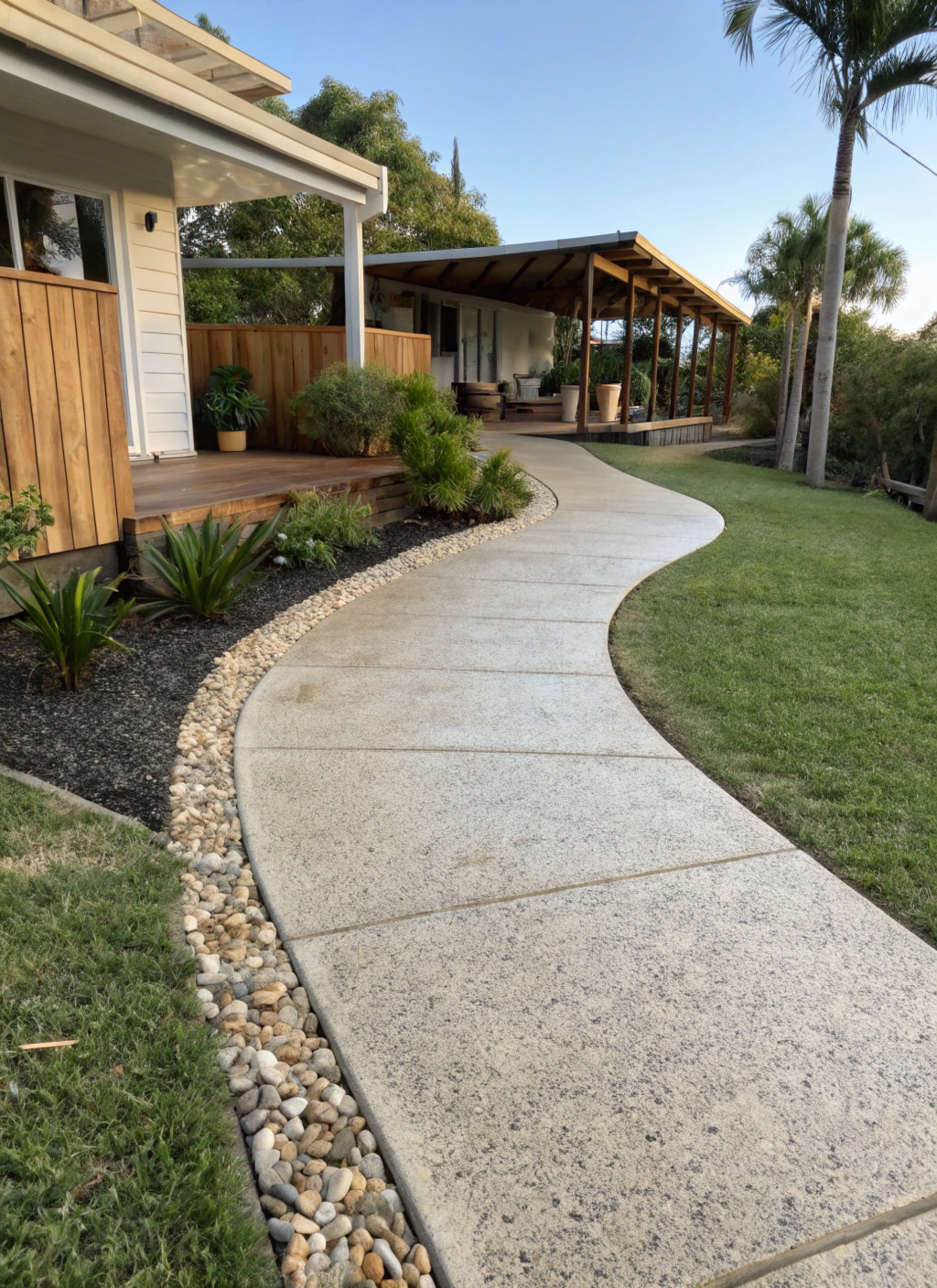
The finish on a concrete footpath does more than determine how it looks — it directly affects how safe and functional the surface is underfoot. Different finishes suit different applications, and the right choice depends on where the path is located, how much foot traffic it carries, and whether aesthetics are a priority for the project.
A broom finish is the most widely used finish for concrete footpaths and for good reason. Dragging a broom across the surface while the concrete is still workable creates a fine texture that provides reliable grip in wet conditions — the kind of all-weather slip resistance that matters on an outdoor path, particularly around Hervey Bay where afternoon storms and coastal humidity are part of daily life.
For residential properties where the footpath is a visible feature — a front entry path, a path connecting an entertaining area, or a side access that runs alongside the home — there are decorative finish options worth considering. An exposed aggregate finish adds texture and visual interest while maintaining excellent slip resistance. A stencilled or pattern finish can complement existing paving or outdoor design themes. A honed or semi-polished finish suits more contemporary residential applications where the path needs to read as part of a considered outdoor space rather than purely a functional surface.
Footpath Drainage and Levels — Getting It Right from the Start
A concrete footpath that pools water after rain is a slip hazard and a long-term maintenance problem. Getting the levels right from the start — before the formwork goes in and well before the pour — is what separates a footpath that performs well from one that causes headaches down the track.
Across Hervey Bay and the Fraser Coast, we account for drainage as part of every footpath layout. The key considerations we work through on every job include:
- Cross-fall across the path width to direct water off the surface and away from structures
- Longitudinal fall along the path length where the terrain or site conditions require it
- Transition points where the path meets other surfaces — entry steps, existing paving, lawn edges, or kerbing
- Stormwater direction to make sure runoff isn’t redirected toward the home’s foundation or neighbouring properties
In parts of Hervey Bay where clay soils and seasonal wet periods are a known factor, drainage planning is particularly worth getting right. Water that sits under or around a concrete path accelerates deterioration and contributes to slab movement over time. We factor all of this into the layout well before concrete is ever ordered.
Slab Thickness and Reinforcement for Footpaths
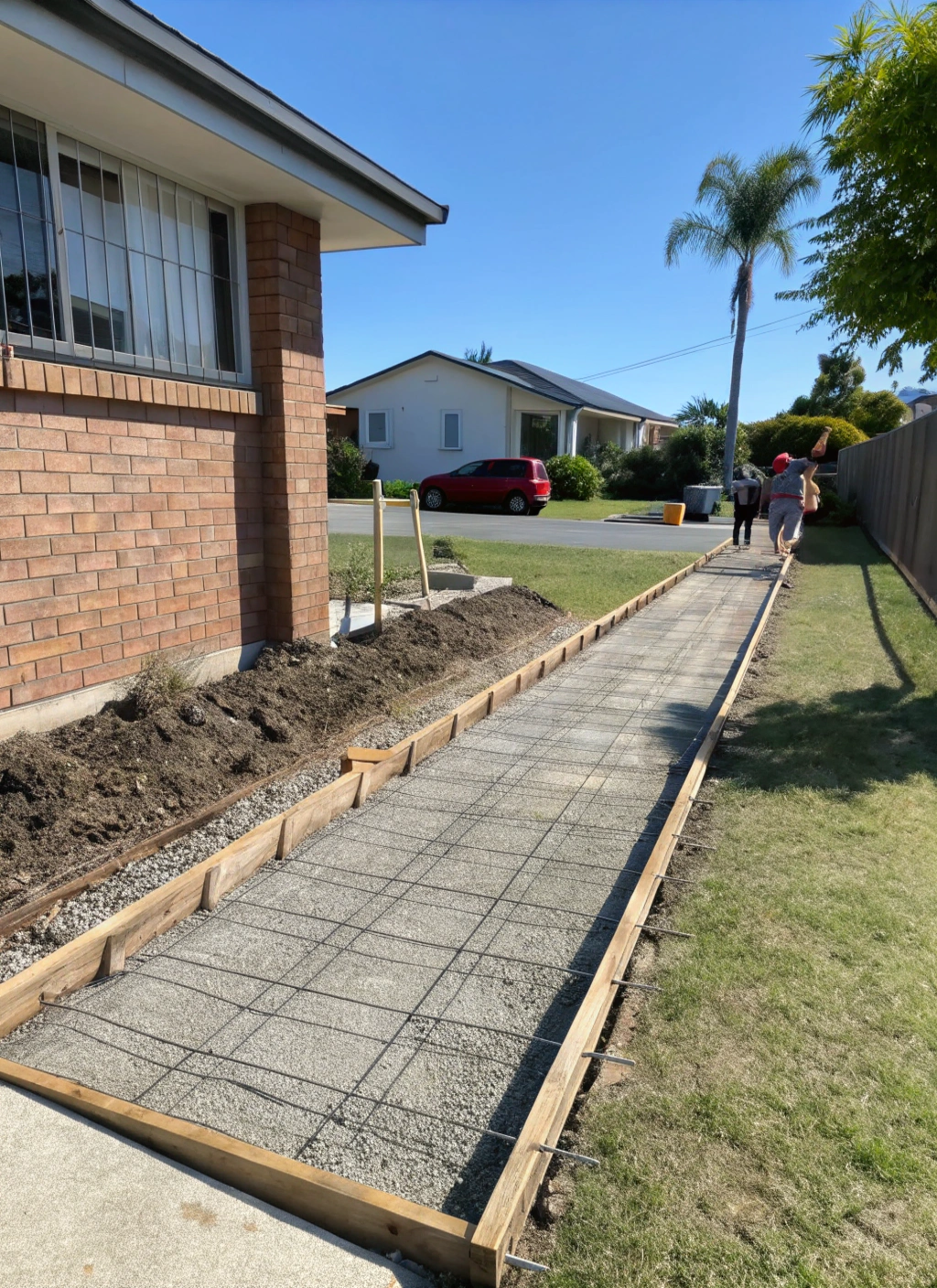
Not every concrete footpath needs to be built the same way. The appropriate slab thickness and reinforcement specification depends on where the path is located, what it needs to carry, and what the ground conditions are underneath — and getting this right at the planning stage is what determines how the path holds up over the years ahead.
For standard residential footpaths carrying foot traffic only, a 100mm slab thickness is generally the appropriate specification. Where a path crosses a driveway, carries heavier foot traffic, or is subject to occasional light vehicle crossings — a common scenario on Hervey Bay residential blocks with wide side access — thickness is increased accordingly, and reinforcement is incorporated into the slab to handle the additional load.
Reinforcement for footpaths typically takes the form of steel mesh laid within the slab. This doesn’t prevent the concrete from developing hairline cracks as it cures and moves, but it holds the slab together and maintains its structural integrity if cracking does occur. On sites across the Fraser Coast where clay soil movement is a known factor, reinforcement adds a meaningful layer of protection to the finished path and is something we factor into our specifications from the outset.
Accessibility Compliance for Concrete Footpaths in Hervey Bay
Commercial and public-adjacent footpath work in Queensland carries accessibility requirements that residential path installations generally don’t. For business owners, developers, and commercial operators across the Fraser Coast, understanding these requirements before the job starts saves significant time and cost compared to rectifying non-compliant work after the fact.
The National Construction Code and the Disability Discrimination Act set out the standards that apply to footpaths in commercial and public settings. The key compliance areas we work to include:
- Path width — commercial pedestrian paths require minimum clear widths to allow wheelchair and mobility aid access
- Gradient along the path length — maximum gradients apply to accessible paths, with steeper grades requiring compliant ramp treatments
- Cross-fall — limited to a maximum gradient across the path width to avoid creating a tipping risk for mobility aid users
- Surface texture — the finish must provide adequate slip resistance under wet conditions to meet accessibility standards
- Kerb ramps and transitions — where a path meets a road or kerb, compliant kerb ramp specifications apply
For residential footpath work, accessibility considerations are less prescriptive but still worth factoring in — particularly for clients planning ahead for ageing in place or building to accommodate family members with mobility needs. We bring the same level of attention to gradient and surface specification regardless of the project scale, and we’re across the local requirements that apply to footpath work across Hervey Bay and the broader Fraser Coast region.
Frequently Asked Questions
Most residential footpath projects take 2-3 days from start to finish, including curing time.
Yes! We’re experienced at matching colour and texture to blend with your concrete features.
Generally not for private property pathways, we’ll help determine if your project needs permits.
Yes, we take great care to protect your plants and trees during installation.
Typically, we can schedule your installation within 1-2 weeks of approving your quote.
Concrete provides a seamless, stable surface that won’t shift or settle like pavers or gravel. It requires less maintenance, lasts longer, and offers more design flexibility.
We design a slight cross-slope into your footpath to prevent water pooling and can incorporate drainage solutions for areas with heavy rainfall.
Absolutely. We use a specialised mix designed for coastal environments, with additional reinforcement and sealing to protect against salt exposure and UV damage.
Contact Us
Ready to transform your property with a beautiful, long-lasting concrete footpath? The Coastal Concreters Hervey Bay team is standing by to bring your vision to life! Don’t settle for uneven, muddy, or deteriorating pathways when a durable, low-maintenance solution is just a call away. Our friendly consultants are ready to answer your questions, provide expert advice, and schedule your free on-site assessment. Take the first step toward enhancing your property’s accessibility, safety, and curb appeal by reaching out today—because great outdoor spaces begin with significant pathways.
Phone: 0741449742
Email: info@concretersherveybay.com
Hours: Monday-Friday, 7 am-5 pm. Saturday 8 am-12 pm
We serve all areas throughout Hervey Bay and surrounding communities.
